
Student Engineers Admitted into Jacob’s Ladder Africa GreenLabs Incubator
Three engineering student teams from the University of Nairobi have secured direct entry into Jacob’s Ladder Africa’s GreenLabs Incubator after standout performances at student-led Green Tech Conference 4.0. These student teams are stepping into a tailored ecosystem: gaining high-level mentorship, market development support, and deep entrepreneurial networks needed to scale their prototypes into profitable green enterprises.
The Green Tech Conference, held on March 26, 2026 at the Chandaria Auditorium, UoN Towers under the theme Sustainable by Design – Reshaping Product Life Cycles with Tech. The conference was organized and run entirely by the Engineering Students Association (ESA)- logistics, moderation, the project judging - all of it, student-run. ESA Chairperson Onkoba Matoke set the tone early. "We are not waiting to inherit the profession," he said in his opening address. "We are already practising it."
The one-day event drew participants from Kenyatta University, Jomo Kenyatta University of Agriculture and Technology, and the Technical University of Kenya, alongside industry representatives from KenGen, Vivo Energy, Jacob's Ladder Africa, KEPRO, and the WEEE Center.
The urgency of building these market-ready startups was underscored during the opening ceremony by Prof. Maina Wagacha, Director of the Intellectual Property Management Office (IPMO), Division of Research, Innovation and Enterprise. "Sustainability cannot be an afterthought," he stressed. "It must be embedded in the very ideation and design phase of every product." He explained how emerging tech like AI and blockchain now allows engineers to shift sustainability from a regulatory checkbox into a core design parameter. Crucially, Prof. Wagacha tied this directly to commercialization: green design is a driver of business value. By designing with the environment in mind from day one, innovators lower production risks and build scalable, profitable enterprises. "You are not just the engineers of tomorrow," he concluded. "You are the sustainability leaders of today."
That message carried into the afternoon, when Mr. Micheal Anindo from Intellectual Property Management Office presented a session on how the IPMO supports student innovators. He took participants through the process of filing patents for engineering inventions and securing copyright for software solutions. For students who had just displayed live prototypes in a competitive setting, the timing was perfect. The aim of this session was to sensitize student innovators to always protect their ideas.
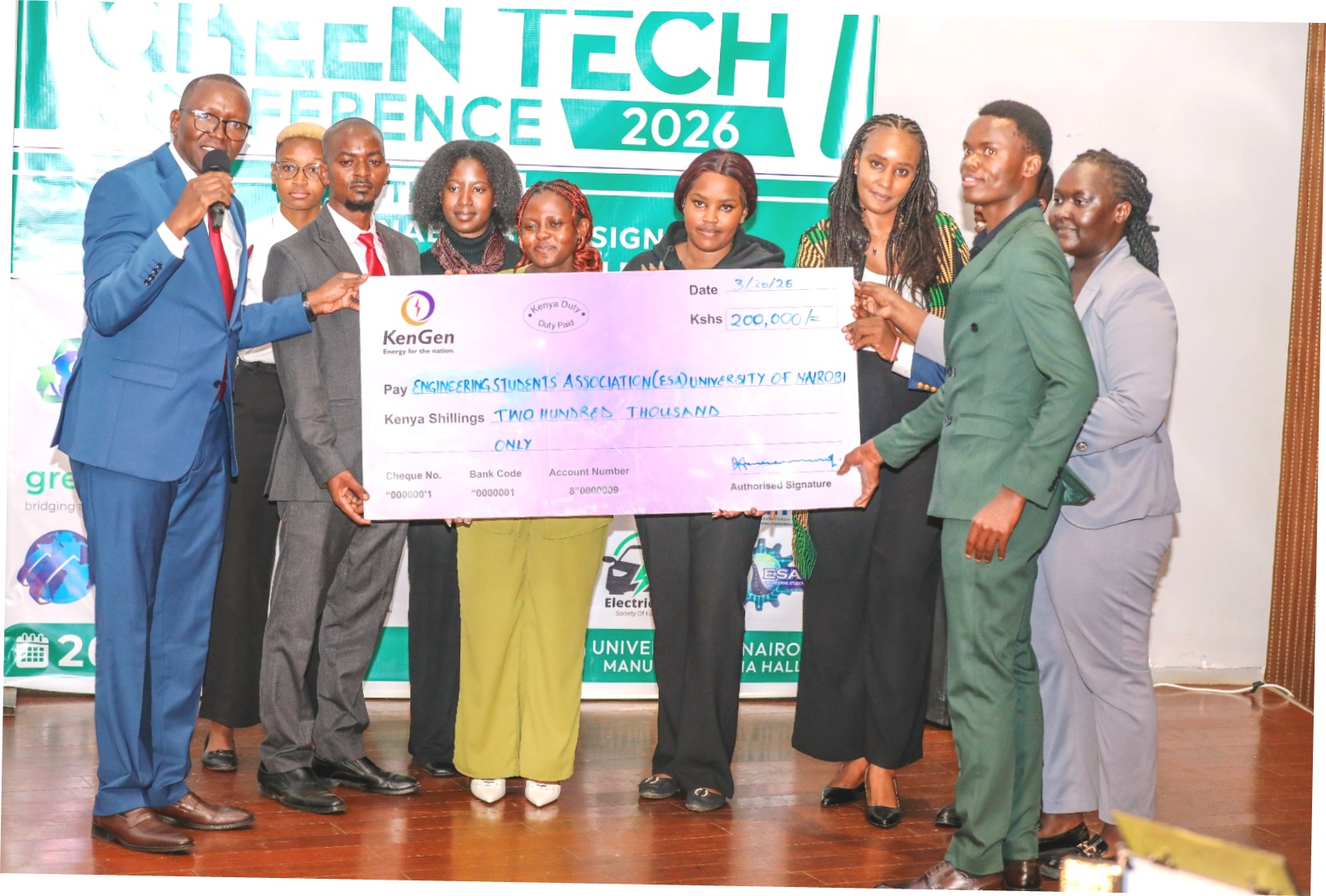
Chief Guest Eng. Harrison Keter, KenGen's Power Generation Manager for the Eastern Region, used his address to close the gap between aspiration and obligation. "Innovation and sustainability are inseparable," he told delegates. "They are no longer optional considerations. They are essential and mandatory." He pressed students to question the energy cost of the products they build, not just the performance. "The programmes we run will define the sustainability of generations to come," he said.His closing line drew a direct response from the room. "Think beyond the grade. Be the generation that designs innovations that truly matter." Eng. Keter also presented a cheque of KES 200,000 to ESA in support of student activities, a contribution that backed KenGen's public commitment to university engagement with a practical one.
Ms. Karen Chelang'at, Chief Innovation Officer at Jacob's Ladder Africa and the conference's keynote speaker, challenged students to account for the full life cycle of what they build. "Think about the whole life cycle of the product," she said. "Solve the needs of the people." Through greenlabs, Jacob's Ladder Africa provides structured incubation to move ideas from concept to commercial viability, with the top three conference teams receiving direct entry into the programme.
The programme moved through the product life cycle in sequence. The first panel covered resource and energy management, with contributions from KenGen engineers, Vivo Energy's Jeffrey Mbugua, and Vincent Otieno of Eco AquaSmart. The second addressed ethics in green technology, examining data center energy use and the environmental cost of EV battery mineral extraction. The third panel focused on public consumption and waste, with panelists from KEPRO, the WEEE Center, and UoN's Department of Environmental and Biosystems Engineering. Student moderators Micky Maina, Enock Nyamogo, and Anne Musyoka led the three panel discussions respectively.
The conference is now in its fourth year and has grown in industry participation with each edition. For the three teams entering Greenlabs Incubator, attention moves from the auditorium to application. Whether the broader cohort carries the day's discussions into viable projects will become clear in the months ahead, when the real engineering begins.
- Log in to post comments


